Sitecore Commerce 8.2.1 – How can the new commerce be classified ?
Recently, the new Sitecore Commerce has been released. In an earlier article, I have already dealt with the question of what the new Sitecore Commerce is and how it is technically built. Now I would
Recently, the new Sitecore Commerce has been released. In an earlier article, I have already dealt with the question of what the new Sitecore Commerce is and how it is technically built. Now I would like to focus on the question
How can the new Sitecore Commerce be classified?
In order to answer this question adequately, I will first give an overview of what e-commerce really is, what commerce systems exist and what modern commerce systems have to do in order to survive the market. In the following, I will show the characteristic feature of the new Sitecore Commerce. In conclusion, I try to make an assessment as to whether the new Sitecore Commerce is able to keep up with its features.
Definition
To say what e-commerce is actually exactly, I start with quoting here simply the Wikipedia definition of e-commerce:
E-commerce is a transaction of buying or selling online. Electronic commerce draws on technologies such as mobile commerce, electronic funds transfer, supply chain management, Internet marketing, online transaction processing, electronic data interchange (EDI), inventory management systems, and automated data collection systems. Modern electronic commerce typically uses the World Wide Web for at least one part of the transaction’s life cycle although it may also use other technologies such as e-mail. …
Following this definition, e-commerce begins as soon as sales processes are processed online. This includes things such as “Online shopping”, “Online Marketplaces”, “B2C” (“Buisness to Customer”), “B2B (Buisness to Buisness) Transactions” etc.
Classification of commerce systems
If you look around the market, you will quickly see examples of various e-commerce systems. So there is “Amazon”, “eBay”, “Magento”, “uCommerce”, “hybris”, “Woo Commerce” to name just a few of the more well-known There are already a lot of commerce systems on the market. The question now is how does all these systems differ from each other?
To answer this question, we can try to classify e-commerce solutions very roughly into different categories, so as to recognize where the individual systems are located.
- Entry-level solution
- Professional applications
- Enterprise-Systeme
Entry-level solutions are characterized by the fact that they are more suitable for simple business models with a small range of products, few connections to external interfaces and usually without programming knowledge. The budget for such solutions is also very low compared to other systems. However, these systems do not allow for large individualizations. Examples include “Woo Commerce” or “Drupal Commerce”.
Professional applications, on the other hand, already have higher requirements, for example because of a wider range of products. This makes it necessary to offer fancier and intelligent search and filter possibilities. In such solutions, it is very common to use various external interfaces, which then have to be connected, what results in a higher complexity. Also, because of these reasons, it is expected that visitor numbers will be significantly higher than entry-level solutions, resulting in higher performance requirements. Such solutions are generally also associated with higher costs, for example, in licensing or implementation. However, it is then also possible to customize the solution in a way, that the personal requirement are fulfilled. Examples of this would be “Magento” or “Shopware”.
Enterprise systems are located where highly complex customer and distribution structures prevail. On the one hand, the associated license costs for such solutions are many times higher than, for example, in professional applications. On the other hand, some high implementation costs are also necessary in order to tailor the solution to the complex, individual needs. The overall costs for such solutions are thus usually drastically higher than, for example, in simple professional applications. Examples of this would be “hybris” or “Intershop”.
Sales
As you can see from the outset, the individual e-commerce systems have their own strengths and weaknesses, positioning themselves in their own market segment. Fig. 1 shows in a very clear way a division into the market of the Top 1000 online shops
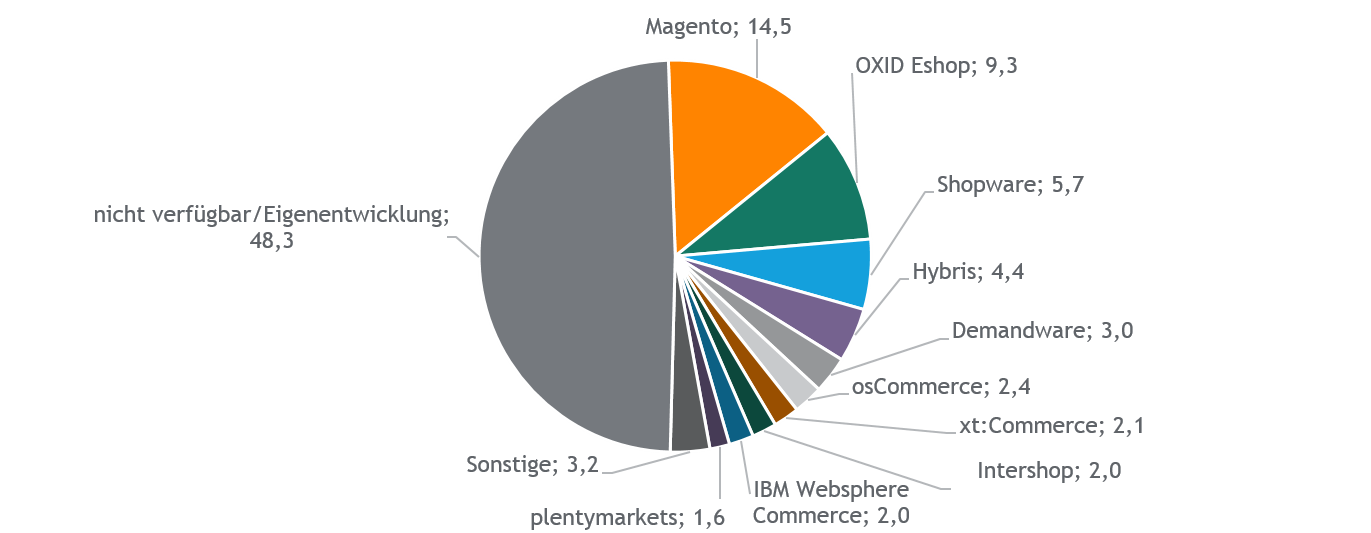
Please note that the majority of the diagrams are either proprietary developments such as Amazon or eBay or simply could not be covered by the tool used.
As you can see, the various e-commerce systems exist and all have their own strengths and weaknesses, but the market is clearly dominated by the “proprietary developments”. The remaining e-commerce systems, which are based on certain technologies, already fall back very clearly and only make up a small share. In addition, it should also be clearly stated here that, although some market systems appear to be low on the market, sales are much higher. For this purpose, Fig. 2 can be used. Comparing these with Fig. 1, it can be seen, for example, that hybris has only smaller market shares, but generates higher sales than other systems with higher market shares. Therefore this must always be set in relation to each other.
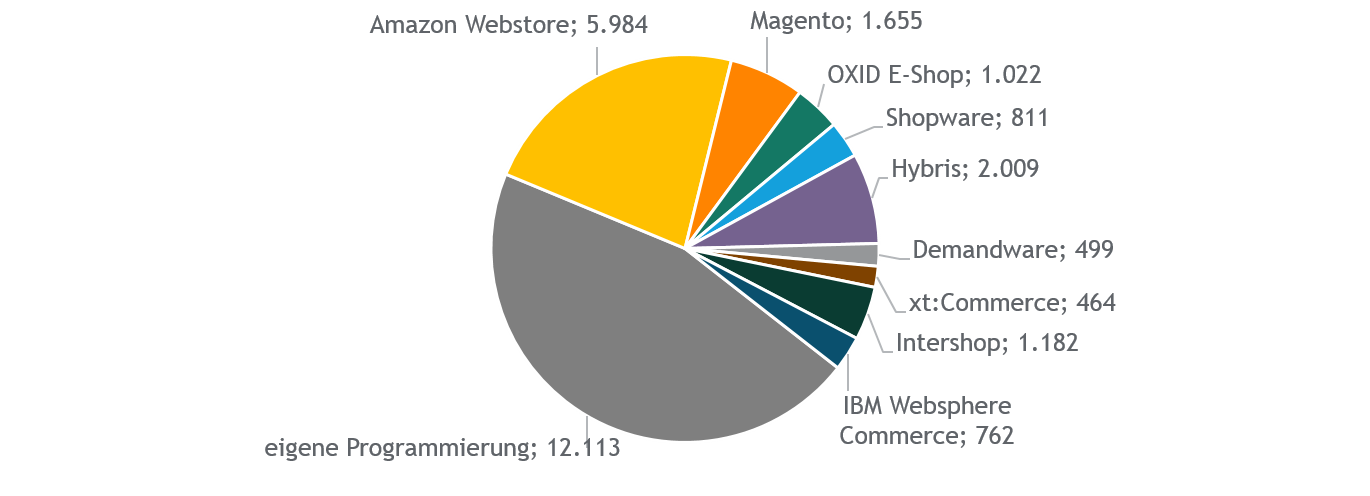
As you can already see, the e-commerce market is highly competitive and highly professional.
Demands on commerce systems
The whole subject of e-commerce has been changing for years. Where in the past it was possible to offer their goods online in some way, the demands of the consumers have increased enormously these days. Both usability and design have become more important than ever, and are presumed to be “must-haves”, so differentiation to other shops or systems must take place at a different level. Nowadays it is the core point not to allow the user to make the actual purchase himself, but to accompany him over the entire Customer Journey and to bring him such a shopping experience. In concrete terms, this means to accompany the customer from the information-gathering, the actual purchase decision to the after-sale. Important aspects are, for example, to offer customized information to the customers individually and personalized. Another aspect is the recognition of a customer through various touchpoints, such as social media, emails or the web, across a variety of devices such as smartphones, tablets or notebooks. Such aspects allow to adress customers with the right information at the right time
Sitecore Commerce feature und functionality
Exactly in this situation is now Sitecore with the new Commerce release. The question is, how does Sitecore deal with this market situation and is even more important, how is Sitecore related to the requirements and market segments. The answer to these questions is essential in order to be able to clarify at this early stage, for which customers, for example, Sitecore Commerce is at all possible, but also in order to clearly identify the differentiation characteristics of the claims. In order to answer these questions, however, let’s look at the commerce with regard to the feature once more.
At this point, I would like to start with an excerpt from the Sitecore Commerce documentation, where a few general technical corefeature are mentioned.
- A simple, lean, extensible framework as a core, with all higher-level functionality implemented as plugins.
- Provides opt-in complexity by allowing customers and partners to take dependencies on only the information model and behaviors that they need. This allows simple down-market hosted solutions to use complex global enterprise solutions without modifying the core architecture.
- Lightweight hosting.
- Using the existing Sitecore Connect pipelines for commerce runtime, with a new Service API for business user scenarios.
- Using the Sitecore Experience Platform for runtime shopping experience and business users.
- The existing subsystems remain in place for backwards compatibility, with opportunities for customers to migrate for newer capabilities and experiences.
Source: (2)
On some of these points, I would like to lay the main focus, as they generally provide a good overview of the scope of functions and the type of architecture.
The first two aspects are related to the architecture of Sitecore Commerce. Basically, the Commerce System is equipped with a basic set of services and features to set up and operate a basic commerce system. Such delivered features are listed in the following table.
- Shopping Cart — Manage interactions with a shopping cart.
- Checkout — Accept additional information during checkout.
- Order Capture — Capture an order after checkout.
- Shops — Shops support provides the ability to administrate multiple shops, both online branded and physical shops.
- Catalog — Abstract pipelines for integrating with other catalog systems.
- Availability — Manage the availability of sellable items.
- Inventory — Abstract artifacts for integrating with external inventory systems.
- Entitlements — Manage digital product ownership.
- Fulfillment — Manage orders fulfillment.
- Payments — Manage payment integration.
- Sitecore Commerce Order Service — Post-order capture support.
- Sitecore Commerce Pricing Service — Dynamic pricing that supports the ability to author and calculate at runtime pricing on products based on date, quantity and currency.
- Sitecore Commerce Promotions Service — Provides the ability to define and calculate at run time various promotions that the shop owner may wish to support.
- Sitecore Commerce Entitlement Service — Provides the ability to manage entitlement rights to digital assets to allow sales and support for digital products such as movies, games, or ebooks.
- Views — Business user focused API for a customizable business user experience.
- Dynamic Pricing — Manage pricing by date, currency and quantity in the shopping cart.
- Promotions — A promotion is a unique offer that you present to a targeted group of customers or prospects.
- DevOps — Support for extension through development and deployment.
Source: (3)
All these functionalities can be set up and administrated by providing business tools such as Customer and Order Manager, Price and Promotion Manager or Merchandising Manager. In my oppinion, this gives you a fairly good overview of the vast range of services offered by Sitecore Commerce and the rough way of administating, even if you do not know at this time, of course, what exactly is behind it. Basically, however, you can say that in terms of the demands on design and useability, for example, Sitecore Commerce has good potential to cover them. However, I had already pointed out in the beginning that this is nowadays not enough to be able to persist in the market permanently. Here, the differentiation factors are very important. Therefore, I now make an attempt to show how exactly this might look with Sitecore Commerce.
Differentiation factors
Now we come to the question of how Sitecore Commerce can differentiate itself from other commerce systems. Even before you have actually seen the system in action or even tried it, this is certainly hard to answer. However, you can now already hold some obvious feature. Here the points 4 and 5 from the previous listing are explicitly mentioned.
Because Sitecore is basically a CMS, which delivers now on top commerce functionality, Sitecore delvers out-of-the-box obviously all advantages or features from the Core Sitecore XP. ´Since the release of the version 7.5, when the xDB was integrated into Sitecore and was introduced the first time, the topics experience and personalization have been developed a lot. According to the Gartner Magic Quadrant 2016, in which the most common CMS systems are compared, Sitecore is clearly one of the leading CMS systems on the market, especially with the latest release of version 8.2, which is the basis for the new commerce. I will not go into the xDB and its feature here, but if you would like to know in detail what is behind the term xDB, you can look at these slides, which bring the whole concise to the point.
Specifically, data on user movements and actions can be gathered, for example, where and how they were on the page, what they looked at, and where they had even jumped from the website. The whole can, of course, also be collected in the area of commerce, where you can then see which products were viewed by customers, how they filled their trays, how often they visited the site, etc.
It is thus possible through the symbiosis of the standard Sitecore XP / Sitecore xDB and Commerce, to track the customer’s entire customer journey from entering via a touchpoint, such as the website directly, a newsletter, for example from the Sitecore EXM, or the social media over the surfing within the website up to the final purchase, neverthelesse which device like laptop, tablet or smartphone is used. These data are then ideally suited to further improve the customers’ buying experience in the future and thus ultimately enable better user bindings and a higher rate of returnees.
In this context, of course, the complete product staging by means of personalization and the collected data can be designed completely individually for the customer. Starting from the content visible on the pages, which texts are displayed, to the offer of various discounts, advertising campaigns or coupons for different users or entire user groups, by means of personalized rules or data gathered by Sitecore XP.
I would also like to pay particular attention to the performance of Sitecore Commerce. This is the case when you read the documentation or also speak with Sitecore contacts, that special value was placed on a high-performance solution. On the one hand achieved by using .NET Core, the latest development of Microsoft, which is many times more powerful than the old .NET frameworks. Detailed benchmarks can be found here. On the other hand also by optimized pipelines and processes.
Where is Sitecore Commerce
Now that everything has been described, I finally try to answer the question regarding my point of view, how the new Sitecore Commerce can be potentially classified.
With Sitecore Commerce you get a performance-optimized system with a good basic set of common and interesting features. However, it is also possible to extend this basic set at any time, or even to completely customize it, in order to be able to respond to individual requirements of the customer or the market situation. Because of the Sitecore XP, you have nearly unlimited possibilities regarding personalization and experience. So I would order Sitecore in a first resume between professional applications and enterprise solutions. Sitecore, on the other hand, offers everything to meet the requirements of professional applications. On the other hand, it certainly has the potential to be used in the enterprise sector, as it certainly already offers many features differentiation characteristics that can meet the special and individual requirements in the area of enterprise solutions.
If you take a last look at the demands on onlineshops, I see that Sitecore Commerce has the potential to do it very well by now. The combination of Sitecore XP and Sitecore Commerce has created a symbiosis that can provide a decisive differentiation factor to other systems.
I’m still looking forward to see how Sitecore will surprise us with its commerce system and the next releases and of course what can be seen in a further tecnical deep dive. The next thing you need to look at is whether Sitecore Commerce can hold all of these expectations and requirements, or even exceed them.
- architecture
- dotnet
- sitecore-commerce
- sitecore-platform